London Borough of Redbridge published a draft ‘Climate Change Strategy 2025-30‘ in early July 2025, following sessions of the ‘Clean & Green’ policy development committee and a school essay-writing competition. Below is the response from Wanstead Climate Action, worked on by multiple volunteers. Some of us also sent individual responses. (The draft included 135 actions in five sections: for ease of reference, here is a numbered version of the draft.)
Wanstead Climate Action response to Redbridge Council Draft Climate Change Strategy, September 2025
Thank you for the invitation to comment on LB Redbridge’s (LBR) draft Climate Change Strategy for 2025-2030. Wanstead Climate Action is an unfunded community group with a mailing list of about 400, affiliated with Friends of the Earth, and involved in national and local campaigns both against fossil fuels and on more general environmental issues. We have worked with LBR on projects such as repair cafes and a wildlife hedge.
Some of our comments are refinements and suggestions, while others of our comments may be extensive and fundamental. We would like to see as many of these points included or addressed as possible. Please feel free to copy sections or references from this response if it would help.
Wanstead Climate Action welcomes this draft strategy and the leadership and vision shown by Redbridge Council in recognising the significant impact local government can have in tackling climate change and making a real difference to the future of our planet.
However, the statement that “the Council outlined the organisation’s ambitions to become carbon neutral by 2030 and net zero by 2050 which aligned with both regional and national climate targets” would be a misleading and self-contradictory overarching aim for the strategy; it does not define ‘carbon neutral’ or ‘net zero’ (which according to the IPCC mean the same thing). We argue for increased ambition in line with the Mayor of London and other London boroughs, and suggest net zero 2030 for council operations and 2040 for the borough area, the latter of course reliant largely on national policy. An extended set of council actions are recommended to narrow the gap between the list of actions and aims compatible with the Paris agreement, and the remaining gap should be acknowledged.1 Please see notes and recommendations on this in the ‘Targets’ section of this document.
Having consulted our members some of our main points are:
- The strategy needs to be accompanied by a delivery plan shortly after it is approved with SMART targets for all the aims, quantifying both the action and the outcomes. including in terms of emissions reductions.
- We feel an opportunity has been missed to include biodiversity improvements throughout the strategy; as in the petition currently running, these should be elaborated in an evidence-based nature recovery plan that is incorporated into the new Redbridge plan.
- We would like to see the final version have even more of a Redbridge specific approach with further insights about the demographic of the borough, challenges specifically for Redbridge and evidence-based insights in the proposals
- Several points we have previously discussed with officers and councillors before are not present and could be added. These include a ban on high-carbon advertising on Redbridge owned displays, differential parking charges for larger, less efficient vehicles, completely freeing the pension scheme from fossil fuel risks, and a removal of planning obstacles to rooftop solar.
- We would also suggest the strategy compares against lists of possible actions such from Friends of the Earth/Ashden Trust or Climate Emergency UK for further effective actions to start implementation of as soon as possible. There also are major gaps in the important areas of governance, advocacy and engagement that could be covered by additional sections.
We have also summarised from our members the feedback received on individual targets in the strategy itself:
- Delivery Plan
Wanstead Climate Action feels this is as important as the strategy itself for it to have the necessary leverage and accountability to ensure a real difference is made to improving climate outcomes in Redbridge in the next 5 years.
- Biodiversity
We feel there are missed opportunities for the inclusion of biodiversity in the strategy particularly in the sections:
Advancing Sustainable Building Practice where green roofs and green walls should also be given due consideration as well as solar panels.
We also feel biodiversity needs to be threaded through the encouraging active travel section and engaging with the community section.
We would also like to see biodiversity outcomes being articulated in the strategy or even a separate strategy for biodiversity that sits alongside this document.
Our member Chris Gannaway has expanded on this in his individual response which we support.
Bold changes throughout council operations and policy could support biodiversity, such as reen walls and fully integrated planting into designed structure e.g Bosco Verticale in Milan; more Swift bricks/boxes; and creation of pocket parks to give stepping stones to biodiversity.
- A Redbridge focus
While the content of the report describes the local challenge in terms of economic and health co-benefits and some aspects of extreme weather, we felt the solutions suggested need to be more specific to Redbridge reflecting the borough’s deprivation and cultural diversity especially given its reliance on community involvement.
The strategy assumes communities will engage if they hear about initiatives and we feel this is insufficient. A much deeper level of engaging and informing residents would give a strategy firmer foundation. We also feel there is a real opportunity to address fuel and food poverty in the borough through the adoption of greener lifestyles. We suggest the pollinator pathway model in Redbridge provides a useful model of engaging communities ie identify one road or estate with one or two individuals willing to take on some responsibility and appointing a spokesperson/coordinator. We feel such a model could make a real difference in replicated for tree planting ensuring residents take ownership of after-care and watering. Further, street-by-street retrofit (as campaigned for by Friends of the Earth and hopefully forthcoming from central government) could have a community and educational focus.
We felt an annual report was not sufficient to create a ‘compelling narrative’. Instead we suggest better use be made of household newsletters and borough noticeboards to show what the challenges are and what Redbridge Council is doing to address this.
We also had reservations about public consultations. These must utilise local media eg Wanstead Village Directory, noticeboards and lampposts and individual newsletters to households for them to be meaningful and engaging. Early public engagement in neighbourhood and community groups could drive local improvements the council could support rather than residents often feeling changes are being imposed from the top-down.
We would also like to see more about how planning applications will change in future to reflect the climate emergency we find ourselves in. As it stands the document says on page 22 it ‘will consider’ installing individual measures for non-residential capital programmes and residential Housing Revenue Account (HRA) programmes, such as solar panel systems and heat source pumps. We strongly encourage Redbridge Council to be bolder on this, given the strategy highlights how housing is the biggest contributor of emissions in Redbridge. We need to decide NOW what the minimum requirements for developers will be that will change in the next 5 years? What heat pumps, solar panels etc will developers be required to install? This also needs to be reflected in the council’s own 5 year plan and applied to municipal buildings too. (See BREEAM comments below) and to small-build projects.
- Targets
More of the actions should include quantified targets, for mitigation actions with estimates of the carbon saved in the ‘carbon mitigation’ column.
Installing school solar panels
- As more schools install solar panels we would like to see this target increased annual to speed up the decarbonisation process and to be accompanied by a much-needed educational programme about how to live a more sustainable lifestyle
- There are also multiple other places for solar panels to be installed eg existing car parks
- We commonly hear of the council imposing costs and delays in installing rooftop solar (whether PV, thermal or hybrid), particularly in conservation areas even though they are so positive and make minimal changes to visible appearance. The council should be encouraging and enabling solar installation, and also waive charges for advice or offer free advice on PV, storage and heat pumps. Transition Ilford’s work for residents on small-scale savings has been exemplary, but the ethos needs to be scaled up within the council.
Tree planting
Tree planting has some adaptation benefits in providing shade and evapotranspiration but the mitigation (‘carbon reduction’) benefits have no effect on the ‘slow carbon cycle’ and albedo effects may actually increase warming. (see eg recent article). We might argue that biodiversity is a greater concern when considering increasing tree cover. The wrong trees in the wrong places can reduce biodiversity and harm other habitats. The document says that over 65,000 trees have been planted in the last decade, but does not give figures how many have survived, or the total change in tree cover, area forested or biomass. (Can see for example planting in St Mary’s Avenue where there seems to have been no ongoing care and the new saplings have died.) We suggest biodiversity outcomes be assessed by expert ecologists in a separate plan to deal with the nature emergency in Redbridge.
We encourage Redbridge Council to explore further how popular tree projects might be self-funding eg the establishment of a tree nursery could generate income.
The council needs to appoint a suitably qualified council officer responsible for nature/ecology in the borough. Such an officer could support the existing tree officers to choose the right trees in the right locations for biodiversity.
We would also like to see more focus on preserving existing trees in the borough eg increased Tree Preservation Orders, increased areas of nature reserves/designated nature areas in planning applications to avoid trees and natural undergrowth being cut by land owners in Redbridge.
We also think there could be more innovation in community groups caring for trees eg a mosque taking ownership and caring for a street of trees as well as individuals looking after trees outside their houses/flats
BREEAM compliance
We feel this should be mandatory rather than ‘aim for’ – developers are often focused on profits and will use the ‘affordability’ clause to avoid BREEAM, or use one of its looser specifications. There are existing buildings in Redbridge built to Passivhaus standard and this should be encouraged as well as examples of ‘deep retrofit’.
Travel
While Redbridge has added 20km of cycle lanes in the borough there is still much more that needs to be done given there are over 600 km of roads in the borough. London Cycling Campaign report 2023 calls for improving the most dangerous junctions, becoming a 20mph borough, more traffic calming on streets. ‘it’s hard to see how Redbridge is doing more than talking the talk when it needs to walk the walk now, or more realistically, sprint the sprint!’ We need major efforts and research to enable people to leave their cars at home. Redbridge’s Sustainable Transport Strategy is not environmentally sustainable or sufficient for the climate challenge.
We would like to see stronger moves to ensure the council’s vehicle idling policy is adhered to and flats given priority for bike hangars
EV chargers do not seem to be evenly distributed throughout the borough for some reason with notable EV charging deserts. We hope this will be resolved with the next round of installations.
Changes in national regulation and funding concurrent with development of this strategy mean the council has options to allow on-road EV charging with gullies or other means of cross-charging under pavements. 40% of homes lack a driveway and government has allocated £25m to incentivise cross-charging. This is one thing that could be made much easier for drivers during the term of the plan.
Regarding greener asphalt, we think more porous road and paving surfaces would help alleviate flooding and river pollution. Paved over front gardens continues to be a problem that needs addressing.
Targets and overall strategy aim
A strategy should have a clear overall aim, but the current draft contains errors and contradictions:
“the Council outlined the organisation’s ambitions to become carbon neutral by 2030 and net zero by 2050 which aligned with both regional and national climate targets”
It defines neither ‘carbon neutral’ or ‘net zero’, and nor do previous documents. The IPCC glossary defines these terms as the same thing (bar notionally pairing with a hypothetical carbon-negative area or organisation for ‘carbon neutral’). So why have two targets for the same thing? London region ‘has set a target for London to be net zero carbon by 2030’. The UK has net zero 2050 in law, but the CCC expects different sectors to reach net zero at different times, and since Redbridge has little of the hard-to-abate sectors (aviation, shipping, steel, cement, agriculture), 2050 for the borough/area is too late.
The ambiguity means Redbridge’s targets have been interpreted in different ways:
- By CEUK as council only 2050 https://councilclimatescorecards.uk/councils/london-borough-of-redbridge/
- In an academic article (and by the Climate Change Committee) as net zero 2030 https://pmc.ncbi.nlm.nih.gov/articles/PMC8325881/
- By London Cycling Campaign as 2030 for council operations, Borough net zero by 2050 https://lcc.org.uk/wp-content/uploads/2023/05/LCC-Climate-Safe-Streets-1-Year-On-Full-Report.pdf (an understandable interpretation)
LBR’s original motion was:
“This council resolves to:
Produce a report on Redbridge’s impact on Climate with an appropriate action list to stop climate change that will go to cabinet for approval within 3 months, including measures to:
1. Make the council Carbon neutral by 2030 and being carbon free by 2050, in line with commitments already made by over 40 others other [sic] councils, from Newham and Waltham Forest, to Somerset and Scarborough. …”2
Somerset and Waltham Forest at least were going for authority-wide net zero 2030, with 2050 maybe inserted to the motion late. However, there are material constraints on speed of decarbonising transport and particularly housing, so 2030 now looks less possible than it did in 2019-29.
We propose the following:
a) 2040 for the area as a compromise (justifiable for carbon budgets recommended by CCC, even though it breaches the principle of Paris equity according to CUSP and Tyndall Centre);
b) net zero in 2030 for council operations [b) has since been stated as the intention, including council housing]
This would them match for example the City of Westminster, where the two different targets are clear: “This Climate Emergency Action Plan for Westminster sets out a framework for collective action on climate change to achieve the ambitious target of achieving net zero emissions across the borough by 2040 … In support of Westminster’s Climate Emergency Action Plan, the City Council has set an ambitious target to become net zero by 2030.”
In the 2021 Change Action Plan, ‘the Council outlined the organisation’s ambitions to become carbon neutral by 2030 and net zero by 2050 which aligned with both regional and national climate targets.’ These targets are very confusing and indeed have been since 2019, and are not in fact either clear or aligned. London has an extremely ambitious 2030 zero carbon goal, where the UK as a whole has legislated for 2050. 84% of the world is covered by similar zero carbon targets.3
Is there a risk in revising these targets? Some irresponsible politicians and media have been foolishly suggesting that national targets should be delayed or dropped, which of course means considerably higher cumulative carbon emissions before net zero, greater surface heating, likelihood of permanent geophysical changes and loss of habitable land.
World Court opinion that 1.5 °C is the ‘primary’ target in law. Practically, the 2018 IPCC Special Report on 1.5 °C showed that major irreversible effects occur between 1.5 °C and 2 °C of warming, and further evidence has rapidly mounted since.4
Indicators of Global Climate Change 2024 5 :
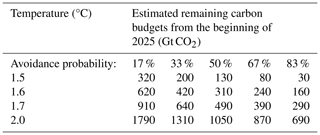
There are many arguing that the current national target of ‘net zero 2050’ is too distant to truly be compatible with the Paris criteria of equity and ‘Common But Differentiated Responsibilities’ (CBDR-RC).6 The UK has much greater capability to mitigate its emissions than developing countries.7 Furthermore, there are indications realated to low-cloud feedback and aerosols that climate sensitivity is probably higher than the 3 °C central value in IPCC WG6, meaning actual carbon budgets are smaller or negative. Even assuming no change in sensitivity, Indicators of Global Climate Change 2024 using same methodology as IPCC reduced these by a further two years.
Despite all these considerations, the Climate and Nature Bill proposes limiting UK emissions to a per-capita proportion of the carbon budget for the 50% chance of 1.5 °C based on the 2021 IPCC report. So this proposed framework legislation is generous compared to a safe limit or international legal obligations, yet much more demanding than current national carbon budgets in law and envisaged by the Climate Change Committee. It is a minimal definition of equity and optimistic, and a value-based decision to use it. The 50:50 criterion for 1.5 °C is imminent, and the remaining carbon budget (RCB) is 130 GtCO₂. The RCB for 1.7 °C (‘well below 2 °C’ in the Paris agreement) is 310 GtCO₂. This gives total per-capita contributions from Redbridge (from start of 2025 until whenever net zero is, and assuming it is maintained) of 4.91 MtCO₂ or about 16 tonnes per resident (Redbridge population: 311,000. World: 8.23 billion). The Tyndall centre calculations have a weaker temperature target and only include territorial emissions from energy use and give a budget of 5.1 MtCO for this₂ which will be consumed around 2027. According to BEIS figures, total territorial CO₂ emissions for Redbridge in 2023 are exactly 650 ktCO₂.
Obstacles
Individual actions and sections could have their own SWOT and PESTLE analyses. The strategy should also acknowledge systemic risks in implementation:
- Lack of understanding of climate urgency and agency throughout council and borough
- Misleading information generated by fossil interests, initially about the climate problem, increasingly about climate solutions
- Lobbying and corruption
- Misleading information propagating through mass media, social media, politicians
- Institutional inertia
- Car culture in outer London
- Gradual slipping into fatalism, apathy, loss of perceived agency and ‘doomism’. (Increasingly you see comments online that ‘life will survive once humans have destroyed themselves’.)
Minor errors
Here are a few minor things in the current draft we haven’t been able to verify:
- 1.5 °C will be breached in 3-5 years, not decades as stated.
- Was 2020 the wettest year for the UK? 2023/24 was wettest winter half-year on record.
- It is not changes in weather patterns to date, but dependence on fossil fuels that has pushed people into fuel poverty.
Strategic direction
Ideally a strategy would involve a connected series of measurable actions with outcomes leading to a defined goal. The strategy should consider not just actions in the 2025-2030 period, but how those enable a pathway to net zero in, for example, 2040. It is also important that the strategy includes commitment to involve the council leader and all departments.
One strategic direction to reduce energy emissions (not just the largest proportion, but causing the most permanent damage) would use the UK government’s target for 95% clean electricity by 2030, the end date of the LBR strategy. Building and transport emissions can therefore be reduced considerably by electrification, and this is recognised in the draft in terms of EV charging. However, the uptake of heat pumps in Redbridge is low relative to the rest of the country and very low compared to the European average, and there is relatively little policy to electrify heating. LBR should therefore consider and prioritise strategies that accelerate building retrofit and electrification of transport.
LBR is currently sixth from the bottom of London councils on the 2025 Council Climate Action Scorecards (with Islington and Hammersmith & Fulham leading the country and Merton top of outer London boroughs). LBR is below London average on every dimension, so there is clear room for improvement relative to other councils. Comparison to best practice elsewhere is solicited in the survey and would be useful to note in the document. We can draw on the CEUK and other scorecards and Ashden case studies.
Framing
The draft has a lengthy preamble that emphasises co-benefits of climate action, such as cleaner air, better health and community and economic growth. These are all real rewards, and there is a general view that positive outcomes can motivate communities; and projects planning for climate resilience can reduce ‘psychological distance’ from the climate crisis. The problem is that they do not convey the urgency of preventing climate tipping points and other carbon-cycle disruptions, and can be conceived of as merely. ‘nice to have’ outcomes. Although thinking about local adaptation to grass fires on Wanstead Flats and flooding in Loxford also reduce the ‘psychological distance’ from the climate emergency, there are potential drawbacks in concentrating on local effects, including understating urgency and effectiveness of mitigation, not appreciating knock-on effects of changes in remote or developing countries and undermining global solidarity.
Potential Energy Coalition finds that although a message about economic co-benefits is effective, a message appealing to care for nature and future generations is twelve times more effective.8 Most people care about nature to at least some extent.
Climate risks are now known to be considerably more severe since LBR first declared a Climate Emergency, according to the Institute and Faculty of Actuaries and University of Exeter.9
The subtitle of the draft includes the phrase ‘more sustainable’. It’s either sustainable or not. One should aim at a ‘sustainable tomorrow’ without the word ‘more’.
Structure
After listing recent policy and engagement events. the draft understandably begins with the two largest-emitting sectors in the Redbridge area and council, namely buildings and transport, both urgently needing addressing. However, in a sense these are not the public or institutional foundations of action, but rather the desired physical result, and so it is worthwhile considering restructuring somewhat to include a ‘governance’ and information section first. For example, traffic-calming projects are more likely to succeed if the ideas are originated within the areas that would benefit, so starting with guidelines about how to fully engage and communicate would serve as a reminder when using the strategy.
More importantly, the gaps between what is proposed and what is necessary for sustainability targets need to be far more explicit in each section, for example adequate central government funding for retrofit. By the end of a strategy that is realistic from a physical point of view, a list of what is needed but absent or threatened should be clearer.
What Mike Berners-Lee writes about the role of business also applies to local authorities and other institutions.10 “The important thing to grasp is that no two of these [three] strands are sufficient on their own. Mitigation alone is undone by rebounds. Enablement alone … does not generally lead to better global stewardship, unless there is a global constraint on the total environmental burden. Enablement and mitigation are both methods by which the global constraints that we need are made possible. 1) Improving own impact … in line with what the best science says needs to be happening. …. cuts carbon emissions of goods and services from ‘end to end’; 2) Enabling others to improve impact; 3) Pushing for global arrangements where needed …. For example, since … dealing with the climate emergency entails a global deal to restrict fossil fuel use … climate change plan has to include pushing clearly and publicly for this to be put in place.” Point 1 roughly corresponds to reducing council emissions, distributed throughout sections 1, 2 and 5 of the draft; Point 2 is largely about borough emissions from residents and businesses; while point 3 is so far largely absent.
Governance, democracy, communication and participation
CEUK also considers this as a separate section. In brief, residents and other non-profit stakeholders need to be deeply embedded in developing individual actions and schemes. LBR needs to pressure central government privately and publicly to get the duties and resources it needs to fulfil any adequate climate strategy.
- Participatory Budgeting for Climate: There is no commitment to giving residents a direct say in how a portion of the climate budget is spent, a powerful tool for engagement used in some Parisian arrondissements.
Advocacy
Any strategy faces threats, from failure to implement systemically to lack of resources, finance, understanding or skills. These may be out of direct council control, and there must therefore be actions to minimise these risk involving funding, suppliers, regulators, and residents. Even if there is no obvious clear pathway yet to achieve necessary goals, the physical necessity of zero carbon means an honest approach is needed when confronting other authorities and institutions that are not yet providing an enabling role, including central government. As in the There Is No Planet B quote, no institution is doing enough on the climate crisis unless they are engaged in frank advocacy. Few of the existing actions fall under this (action 39 lobbying TfL etc).
A council can use its voice as a democratic institution to push for higher-level change that has massive downstream effects. There are some simple actions the Council itself should make with no commitment except to demonstrate increased strategic understanding of climate action.
- Endorse the Fossil Fuel Treaty11
- Endorse the Climate and Nature Bill12
- Become a Leading Advocate for a Carbon Duty (fair CBAM): Join and lead cross-council campaigns to lobby the UK government for a tax on imported goods based on their carbon footprint. This protects UK industry and pressures other countries to decarbonise. Advocating for systemic, national policy changes has the highest potential for large-scale carbon savings. A successful carbon duty could reduce global emissions by millions of tonnes.
- Lobby for an End to Fossil Fuel Subsidies and for “Polluter Pays” Legislation: Use the platform of the council to pass motions and join networks like UK100 to lobby Westminster to redirect subsidies and make polluters pay for the true cost of carbon, as recommended by the IMF and OECD. Removing trillions in global subsidies would drastically reduce fossil fuel consumption worldwide.
- Lobby for stronger building regs (e.g. making EPC C mandatory by 2028), road-user charging powers, or net-zero funding. If Redbridge secures policy shifts affecting 10,000 homes (via retrofit grants or MEES enforcement) and accelerates average retrofit by just 0.5 years, global emissions are cut by ~10,000 homes × 2.2 tCO₂e/year = 22,000 tCO₂e/year (about ten times the reductions by 2030 from currently listed actions).
Advocacy effects are harder to quantify, but even small nudges at central policy level dwarf local project impacts.
Divestment from Fossil Fuels: A explicit commitment to complete divestment of council pensions from fossil fuel companies is absent. This is a cornerstone campaign for FoE and a clear signal of commitment. The draft does not mention responsible investment.
Internal capacity-building
Better delivery of existing commitments through systematic climate impact assessment and enforcement could significantly multiply the effectiveness of council actions.
There could be a commitment to implementing a “climate lens” on all financial decisions or mandatory carbon literacy training for all senior councillors and officers, as seen in authorities like Welsh councils. Actions like “develop a Net Zero training programme” and “create a Climate Change Team” are listed, but they lack the scale, urgency, and mandatory nature seen in leading councils.
- Training staff in carbon literacy, adding “carbon impact” tests to all council decisions, and embedding climate officers in planning, procurement, and finance. If this results in procurement officers shifting just £1m of annual spend to low-carbon suppliers (e.g. recycled materials, renewable energy contracts), typical embodied savings are ~0.05–0.1 kgCO₂e/£ spent. That’s 50–100 tCO₂e/year.
- FoE/Ashden precedent: Cotswold DC and Cornwall Council built climate-literacy training into corporate processes, reporting measurable procurement shifts.
- Make advanced certified carbon literacy training mandatory for all senior councillors and senior officers to help decision-makers understand the quantified implications of their choices.
- Commit to a core, centrally-funded team of at least 5-10 FTE (Full-Time Equivalent) officers across key departments (planning, transport, procurement, housing), not just 1-2 officers hoping to win grants.
- Implement a formal process where all major council reports (e.g., for Cabinet) must include a section assessing the impact of the decision on the council’s carbon budget and net-zero target.
What FoE/Ashden actions can be added to the Redbridge draft
Mention of other councils refers to case studies at groups.friendsoftheearth.uk
- Green finance tools – no use of Community Municipal Investments (local climate bonds) or similar, and no workplace parking levy / housebuilding levy to fund climate infrastructure (case studies: Warrington CMI; Nottingham levy; South Gloucestershire levy). Hammersmith and Fulham is another great example of this.
- Workplace Parking Levy: A charge on employers providing parking spaces, successfully used in Nottingham to fund public transport. This is a major tool for generating revenue for sustainable transport while reducing commuter traffic.
- Pension fund divestment – no commitment to divest council pensions from fossil fuels (e.g., Waltham Forest).
- Formal “Climate & Nature Champions” – I couldn’t see a cabinet-level councillor + lead officer with twice-yearly audited reporting (Cotswold example).
- Deliberative engagement – no citizens’ assembly / structured citizen deliberation on climate priorities (Blaenau Gwent example).
- Local Plan alignment & renewable-area designations – I didn’t find a concrete, time-bound Local Plan climate review or renewables “suitable areas” policy (Lancaster/Stroud examples).
- Just transition & green skills – no programme to further develop local green skills and support SMEs to decarbonise (Dundee/South Lakeland examples).
- Circular economy & waste-prevention – draft has limited emphasis on share/repair/reuse networks, zero-waste/circular strategies, single-use plastic bans, or food-waste programmes (Pembrokeshire, Derry & Strabane, Durham, Bristol examples).
Others
- High-carbon advertising ban. Ban adverts for flights, SUVs, and fossil-fuel companies on council-owned sites (billboards, bus stops, leisure centres). Add to lobbying on TfL to introduce this London-wide. The “Badvertising” campaign estimates advertising adds 28% to consumption of promoted goods. Banning just 10 large SUV billboards could avert about 15 cars sold/year. Each SUV ~3.5 tCO₂e/year vs small car ~2 t, meaning 20 tCO₂e/year avoided, reaching 100 tCO₂/year by 2030. Extending across air travel and fossil-fuel marketing can multiply this by an order of magnitude (>100 tCO₂e/year). Norwich, Liverpool, Edinburgh and Amsterdam councils have already implemented bans.
Retrofitting & Energy Efficiency
Energy use in buildings is of course the largest component of emissions in the borough. DESNZ figures for 2023 still show 16,882 tCO₂/year from public-sector buildings using methane for heating, and 224,500 from domestic properties. Again, what is needed to take these figures to zero by 2040, including external regulation and funding commitments, should be made explicit so that everyone can advocate for it.
The draft lacks a quantified, area-based retrofit target (e.g., “retrofit 5,000 homes to EPC B by 2030”). It relies heavily on securing external funding rather than committing significant core funding, as seen in Manchester’s £78m commitment. The actions are reactive (e.g., “develop a plan”) rather than proactive (“deliver retrofits to X homes per year”). It has been remarked that current rate of retrofit progress in Redbridge, assisted by fractured grant systems from central government, is at less than a tenth of the necessary rate. One of the strengths of the draft was the concentration on local green building skills, which need to be scaled up rapidly in order to meet vital climate goals as well as insulate residents and businesses against further shocks from methane gas price spikes. According to NESTA it only takes a week to re-train a qualified heating engineer to fit heat pumps. However, the social housing sector is plagued with underspecified and poorly-designed and -installed systems, so various systems of certification, monitoring and review should be promoted.
The title of the section 1 is rather restrictive: we suggest replacing ‘modern’ with ‘comfortable’ or similar. Victorian buildings can of course be made sufficiently energy-efficient with enough work. The council should lead schemes to install solid-wall insulation and heat pumps in the private rented sector, with benefits split between landlord and tenant. The current system of grants tends to leave a gap between grant amount and total cost, leaving lower-income people trapped in high-carbon fuel poverty. The council should be facilitating closing that gap, working with all stakeholders and policy-makers, with further grants or loans.
References
1 See https://www.rollingstone.com/politics/politics-news/bill-mckibben-winning-slowly-is-the-same-as-losing-198205/
2https://moderngov.redbridge.gov.uk/ieListDocuments.aspx?CId=272&MId=7915&Ver=4
” the council’s commitment to become carbon neutral by 2030 for those emissions in its direct control whilst also outlining the council’s ambition to become a community leader on climate change.” Action Plan June 2021
“the council’s target to become carbon neutral by 2030 and carbon zero by 2050”
https://www.redbridge.gov.uk/media/10082/appendix-b-climate-change-action-plan-final.pdf
Tyndall Centre carbon budget (archived) is only 5.1 MtCO₂ from 2020 with an exponential decline to ‘reach zero or near zero carbon no later than 2042’. Archived version from April 2025.
Case for UK net zero 2035: https://cusp.ac.uk/themes/s2/zero-carbon-sooner-update/
4https://climatetippingpoints.info/2022/09/09/climate-tipping-points-reassessment-explainer/
5https://doi.org/10.5194/essd-17-2641-2025
6https://www.cusp.ac.uk/themes/aetw/zero-carbon-sooner/
7https://calculator.climateequityreference.org/
8https://potentialenergycoalition.org/later-is-too-late-global-report/
9https://global-tipping-points.org/risk-dashboard/
10There Is No Planet B, 2nd ed, 2021, Cambridge University Press. p 184
 Wanstead Climate Action