We’re getting used to our new, more accessible, home in Wanstead House, and meetings are now regular third Mondays. Many of our regulars couldn’t make October’s meeting, but nine of us managed to agree significant actions.
Maybe every meeting, after a round of introductions and apologies for absence, we can, firstly, reassert that we’re all there for the same reason, to do something for the biosphere we are part of; and secondly begin with a reminder that there is always something needing doing, whether that’s local outreach, social media, practical events, admin or campaigns. It’s fine to just come and observe, but during the meeting maybe someone will find courage to take some initiative, opportunity or inspiration forward. Diane took some notes, but this account is from memory and a chance to share the presentation I had promised (see below).

After September’s follow-up meeting with Cllr Jo Blackman and discussion of Redbridge’s five-year climate plan, I’d suggested a change of format, so the newsletter had advertised the meeting as “a Q&A on climate change with experts on hand. Eg to what extent, if at all, is tree planting or carbon capture an answer, and why should we act if the US, China and India don’t? Plus working on letter writing, and the usual discussions on upcoming events and activities.” We hadn’t actually secured any genuine experts, but the hope was for an interesting challenge to try to answer any questions, either curious or political, we could throw at each other, equipped with various books and resources on the climate crisis.
In the event, there was an hour of constructive discussion before we arrived at these contingency activities, the letter-writing activity could be left fo a future session, and after each section of the hasty science-focused presentation, there were only a few requests for clarification. All the same, the version posted here has been adapted in response, so the session in total was actually nicely interactive. (The newsletter also said ‘Meet 7.00 for socialising, Meeting starts 7.30’ – we have the room from 7pm, but note that the bar for Wanstead House members doesn’t open until 7.30. One disadvantage of no longer meeting in the Bull.)
We covered preparations for the Repair Café the coming Saturday (which was busy and went went very well, including in terms of number of items fixed), and the following one on 29 November; venues and choices for possible public film showings; and ways to promote the Redbridge nature emergency petition through messaging apps (which have since garnered at least 200 new signatures), and at our outreach at the next High St market day on 2 Nov (three volunteers). There was some general catching-up to do especially as it was the first meeting for one person who had already been active with WCA. We confirmed a discussion for the 19 January 2026 meeting with a Redbridge officer responsible for trees and verges – always a popular topic.
Bigger and more abstract topics did crop up naturally. Is it enough information for politicians to be aware that humans are causing dangerous climate change, to act on it? Some said yes, there’s no excuse for inaction knowing what we know. I said there is still an immense knowledge gap that lets in confusion and delays, as shown in an important survey of MPs shared by one of our members. So we spent a little time discussing the National Emergency Briefing on Thu 27 Nov to which all MPs have been invited.
And what is the relationship between direct personal action such as repairing and reducing energy usage, and on the other hand political campaigning? In fact even for organisations as large as local authorities, it turns out lobbying is probably the more effective course. Nevertheless there was agreement that we can engage people best by talking to people about whatever actions we ourselves are taking and why we care: ‘virtue signalling is really a good thing’ (at least in terms of offering an example, rather than expecting others to also voluntarily give up their long-haul flights.)
We could expect our thoughts to be shifted towards the global picture by COP30 in Brazil (10-21 Nov), the most important international climate conference for two, or four, or more years. Many information-packed reports are released in the run up (such as WRI’s State of Climate Action report, the Production Gap Report, Emissions Gap Report and Global Carbon Budget, due imminently) and one would hope would focus media and political minds. Friends of the Earth is promoting the day of action for climate justice on 15 Nov. There will be a team of us going from Wanstead Station at 11am to the central London location (which now turns out to be Downing St). Please come and invite a friend – we discussed how the purpose of demonstrating is not just to show support to government for causes like climate justice, but at a deeper level is a way of connecting with others in a shared hope. It’s good for the soul, and also can be fun.
The presentation was mostly a series of graphs by other people starting from one simple question asked in our WhatsApp group a few months ago: have we actually passed 1.5 °C of global heating already? As with many scientific questions, the answer is nuanced: ‘in the most important sense, probably not quite yet‘.

But is 1.5 °C inevitable? To avoid it we would have to hope for some mass political awakening in the next couple of years. So the presentation covered:
- Why is it warming? (physics)
- What are the risks? (physics, biology, sociology, geology)
- How fast do we need to cut emissions? (physics, chemistry)
- What are the most effective actions? (chemistry, opinion: economics and politics)
Here it is, thrown together in a couple of hours (1.9 MB PDF download), with some revisions in response to comments:

It didn’t really attempt to answer the topical, political points, just provide factual background for discussing them and campaigning. Not only did we not get around to the letter-writing, I didn’t find any time for the questions sent in by people who couldn’t attend. People may differ about the priorities I arrive at and my answers below.
Q: ‘to what extent, if at all, is tree planting or carbon capture an answer’?
This conversation had surfaced at previous meetings. Tree planting may be of some use for local cooling and shade in cities (adaptation); some say carbon capture into rock is a form of decarbonisation (‘mitigation’), but will it ever be economic and sustainable at sufficient scale? An argument I advance is that what we do in the biosphere is ultimately unimportant* compared to the ‘slow carbon cycle’ dominated by fossil fuel extraction:
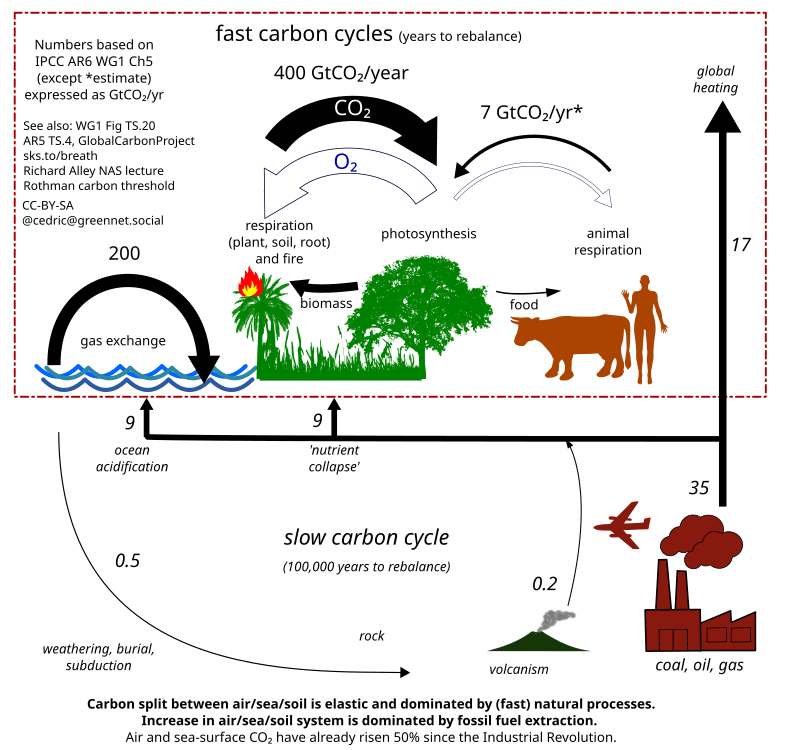
(*that sounds bad, on re-reading. Pretty much everything humans are evolved to do is ‘in the biosphere’. I wasn’t meaning action to care for living beings and landscapes is unimportant! It’s just ultimately not particularly relevant to the carbon problem that potentially undermines all that care.)
Q: ‘why should we act if the US, China and India don’t?’
The questioner apparently has persuasive good answers to this, which we can discuss in future. The ‘we’ in the question is presumably ‘the UK’ rather than ‘people in and around Wanstead’. There are problems inherent in the question. It’s conditional on something that is not the case: California and China both have emission trading schemes, for example. If we all go at the speed of the slowest, we really are doomed.
And why is it conditional at all? The conclusion from the presentation was no new fossil fuels, anywhere: logically, ‘we’ should act regardless; plus that’s one way to encourage others. ‘What about China’ is one of the most common of the discourses of climate delay, described as a way to redirect responsibility: ‘Whataboutism focuses attention on distant perpetrators of climate harm over which the … audience have limited control. This discourse often exploits confusion between aggregate levels of emissions and per capita emissions…. The strategy also works for industries’. In fact, if you consider the UK’s capabilities or historical responsibilities, it should decarbonise much faster than the rest of the world.
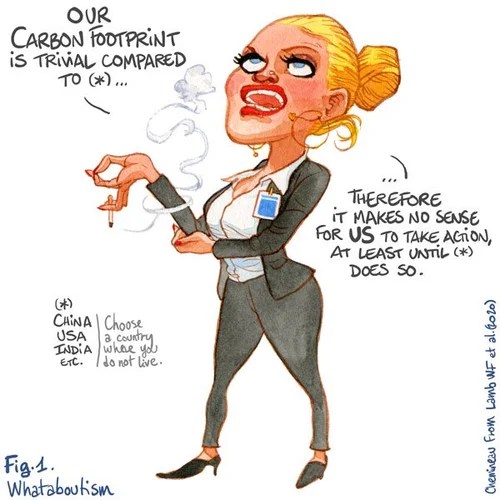
Léonard Chemineau, CC BY-NC-ND
Related to this, most economists find that strong climate action delivers major benefits for the UK – even if the rest of the world didn’t act. Kathy, who wasn’t able to attend, also asked for responses to a couple of related challenges from politicians, such as repeated incorrect and confusing statements made by the Conservatives’ current energy and equalities speaker, Claire Coutinho. One political meme was supposed to link social and environmental levies with total fuel bills, but actually such levies have reduced bills particularly of those with lowest incomes.
When in power, the Conservatives initially did something fairly sensible to cope with increased gas prices: redistribute public funds to each bill-payer (it would have been even more progressive if it had be to each person), rewarding thrift and still constraining demand (with some residual inequities). Greenpeace has an interesting petition to greatly reduce electricity electricity prices. At the moment the UK does have the highest domestic electricity (not gas) prices in Europe, excepting Germany (although Italy and Denmark are also close), because 98% of the time the UK unit price is set by generation from fossil methane. The Greenpeace proposal puts gas turbine generators on a ‘regulated asset base‘, effectively capping their profits. Rebalancing bills so levies are moved off electricity has been suggested by the CCC, but importantly not in a way that slows essential efficiency and renewables. (I would favour increasing the price of gas through CBAM and production fees, while directing insulation and electrification measures intially at those most in need – because this is a climate crisis after all – so that any short-term ‘losers’ are the affluent and deliberately spendthrift.)
Then there is the claim that zero carbon is ‘unaffordable’, presumably to be interpreted as an unwillingness to invest in a habitable future. Here’s Simon Clark PhD and friends:
Another falsehood repeated by Coutinho, on the separate subject of the North Sea, is that imported LNG produces ‘four times’ the emissions of domestic methane. This completely ignores the major component of emissions: burning the stuff. It is true that there are some energy and financial overheads for methane liquefaction, just as up to half of production can displaced overseas, but even accounting for those, a North Sea gas field like Jackdaw is a carbon bomb. Policy-makers should avoid detonating it.
So, it seems we do want to improve (and simplify) our responses to these discourses of delay in media and politics, but ignoring all this, the end of the meeting did refocus on one very imminent concern, the Rosebank oil field which is up for a new government decision in the next few weeks or months. We have Stop Rosebank briefings and materials, including pre-printed cards, or just email your MP. Or come to the pickets at 8-9am Mon-Fri outside DESNZ (dances optional).
For a future session, we can do the letter-writing (or Q&A). Maybe even send Christmas cards informing public figures about positive actions. As you can tell, very little preparation was done for this part of the session:
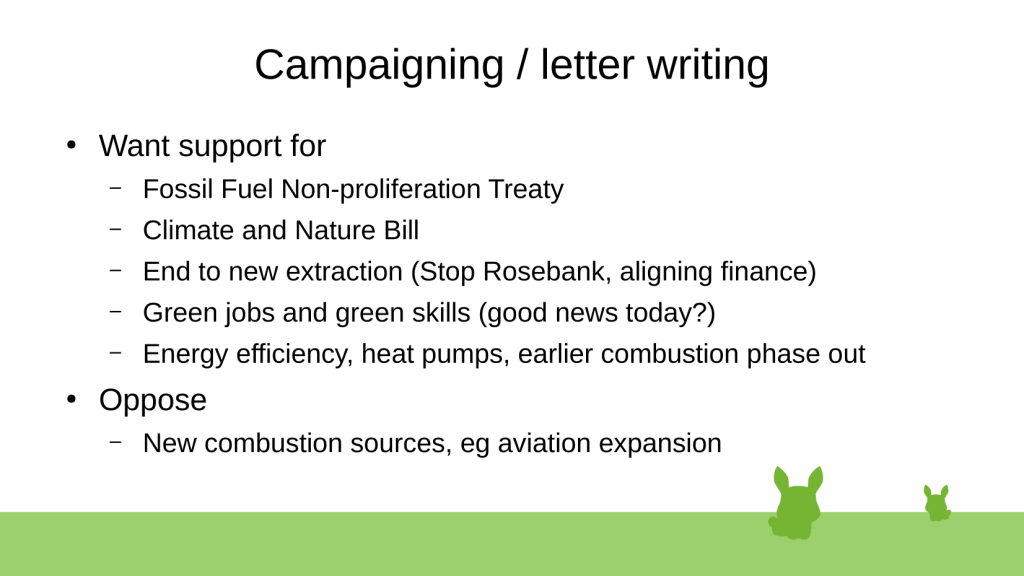

Suggestions welcome before or at the next meeting. We could do with some experts too.
Blog by CK. Not necessarily the view of WCA.
 Wanstead Climate Action
There’s a brief discussion of big-picture policy solutions in the presentation. It suggests that high carbon pricing would help slow and stop climate breakdown. It’s been a key idea for decades, and the ‘carbon floor price’ may have helped end coal generation in the UK. William Nordhaus even won an economics prize for it (sometimes called the ‘Nobel prize’ for economics although Nobel had nothing to do with it.)
However, we did briefly mention that it can create economic injustices. Are disadvantaged people going to be trapped with increasingly expensive heating and transport because they are unable to afford the up-front costs of cleaner alternatives? A Frequent Flyer Levy is one proposal to change behaviour through pricing that allows for people to take one or two necessary and the occasional leisure trips, while discouraging the rich from frivolous weekend breaks.
Last week in a webinar Prof Tim Lenton, one of the authors of the Global Tipping Points report, gave a forceful argument for ‘mandates’ instead of carbon pricing. Mandates are regulations to instruct industry to clean up its act, and perhaps could be compared to wartime requisitioning, which might be commensurate with the scale of the climate emergency. EV production as a percentage of total sales is one example of the mandate, although in that case inadequate given there are still new internal combustion engines being added to the load of traffic. Nevertheless Norway has used it to get to a position where most cars are EVs. Another poor example would be the ‘sustainable’ aviation fuel (SAF), which is a defined category to be used in a defined percentage. Banning sale of inefficent devices is potentially effective.
So the idea of mandates appeals because it puts the onus on large corporations rather than the consumer and indeed makes it much easier for people to reduce their emissions. And it can be very effective in some ways. However, we shouldn’t just focus on the ‘tailpipe emissions’ – there is also the regulation of corporations that are still extracting carbon from rock so it will enter the environment. A simple ban on new extraction, which is unnecessary, is best, but there is also the idea of a Carbon Take-Back Obligation (CTBO) that means extraction is not permitted unless a percentage (eventally 100%) of carbon equivalent is put into secure geological storage.
In conclusion a mandates approach is one of several approaches to limiting climate risk, probably complementary to others, and should probably have been in the WCA outline presentation. We can return to apply this to particular campaigns soon.
LikeLike