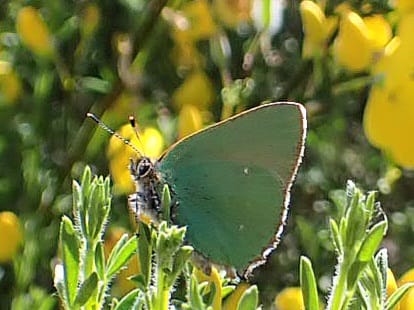
Green Hairstreak Butterfly Callophrys rubi at Wanstead Flats on broom vulnerable to fire
- The UK is one of the world’s most nature-depleted countries. Since 1970, the average decline across all surveyed species has been 19%. Nearly one in six species in the UK is now threatened with extinction (State of Nature 2023, State of Nature Partnership, stateofnature.org.uk). This is the result of land-use changes, climate change and unsustainable development.
- This matters because a healthy natural environment – with the sound of birdsong, buzzing bees and flowing water, and the scent and sight of flowering plants – has been shown to be vital for mental health in the pressurised world of 21st-century London. Having pleasant open spaces in which to walk and cycle is also good for physical wellbeing.
- Redbridge has not been immune to biodiversity decline. In our borough Meadow Pipit (Anthus pratensis) and Spotted Flycatcher (Muscicapa striata) – birds which bred in the borough until recently – are now extinct as breeding species, and Skylark (Alauda arvensis) is close to going the same way.
- However, the situation can be reversed with creative interventions, and there are some fine examples of this locally. For example, Countryside Stewardship have enabled Hainault Farm to attract large numbers of breeding and nesting farmland species, which had previously deserted the site. Management at Claybury Park have enabled scarce Brown Hairstreak butterflies (Thecla betulae) to colonise the site. And work by volunteers along the River Roding is changing the river into one that people will enjoy walking alongside and one that is attracting more biodiversity.
- With its green mosaic of woodland, grassland and river corridors, Redbridge has the potential to be a jewel in London’s crown for biodiversity. The recent London Local Nature Recovery Strategy [LNRS] report highlights improvements that can be made, many of them not being costly to implement.
- By declaring a nature emergency and developing a comprehensive, evidence-based nature recovery action plan, Redbridge will be joining other boroughs – including Camden (2019), Westminster (2023) and Waltham Forest (2025) – in making a commitment to improving our ‘natural capital’. Key elements of this will be embedding nature recovery into all strategic plans and policy areas, and committing to protect and manage at least 30% of council land holdings for nature recovery by 2030 – so contributing to national government nature and climate targets.
 Wanstead Climate Action