On 19 January 2026, our monthly meeting was treated to a talk by Redbridge’s arboricultural and horticultural manager, Peter Marshall. The biggest room in Wanstead House was packed out and sadly we had to turn people away. You can download Peter’s slides here (trimmed to remove some images), or see the links below for more information.
Here’s what struck WCA co-founder Kathy on the day:
Peter from LBR told us that 700 trees a year are planted and all the work they do is done with only four staff!
These trees are sourced from local nurseries or imported from Europe.
Unfortunately, trees do fail for a number of reasons and the failure rates can go up and down.
In 1994 to 2010 there was a 12% failure rate. In 2023 it was 8% (this was the year that they started watering new trees), but in 2024 there was an 18% failure rate. Failure is therefore not due to lack of watering – which now happens 12 times a year for three years. Other reasons for new tree death can be transplant shock, environmental stress, & poor stock. It can also be due to compacted soil (decompaction of soil is beyond the budget).
The council do try to plant a variety of trees. Last year 79 different species were planted. Monocultures can cause diseases to spread. Pines are good for filtering pollution, and black pines have been planted along the Romford Road and in Monkhams estate.
Sorbus (Rowan) have hairy leaves which are good for trapping pollution. Research shows that in order to remove pollution, air must go through leaf canopies, but plane trees may remove particles in the air by physically pushing the polluted air away.
Climate change: By 2090 it is estimated that 73% of London’s public trees may struggle to survive – only a very small percentage are resilient to predicted climatic conditions. 22% are moderately suitable; 62% are of low suitability and 10.6% are vulnerable. Examples of vulnerable tree varieties include Ash, Cherry, and European Birch. Hawthorn varieties are moderately vulnerable, while Beech, Apple ( many Malus varieties), Lime and Sobus are all unsuitable to plant for future resilience. However, other birches (e.g. Betula albosinensus) may be more resilient, as are Southern European species like European oak . Studies are ongoing into survival rates of trees in extreme conditions. The Council stopped replacing chestnut trees some years ago due to their susceptibility to disease (bleeding canker and leaf miner). It has been suggested that Indian horse chestnut may be a suitable alternative.
You may have noticed some oaks have white bands around them and warning signs that they are infected with Oak Processionary Moth. The caterpillars shed spines that can cause severe irritation in humans. Trees that are near schools or over pavements are vacuum cleaned if infested! Birds do eat the caterpillars so it would not make sense to kill all of the caterpillars.
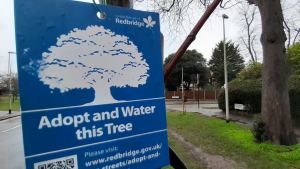
The council have an inspection rota for each road, which can be viewed online and people are encouraged to adopt trees (an informal scheme).
An outstanding question (forgotten who asked it):
Are play areas in council parks treated with herbicide?
I have received confirmation that: No, The Grounds Maintenance team primarily uses:
- High pressure washing to clear moss, algae and surface growth
- Steam treatments for stubborn areas
- Manual removal where appropriate
Useful links
New community portal showing street trees is now available (still beta testing a bit) via www.redbridge.gov.uk/our-streets/attractive-streets/council-trees/
Future Climate Suitability of London’s Public Realm Trees: https://www.london.gov.uk/media/110943/download
Attractive streets: www.redbridge.gov.uk/our-streets/attractive-streets/
Council Trees: www.redbridge.gov.uk/our-streets/attractive-streets/council-trees/
Tree Adoption: www.redbridge.gov.uk/our-streets/attractive-streets/adopt-and-water-a-tree/
Restore Nature Pledge: www.redbridge.gov.uk/our-streets/attractive-streets/restore-nature-pledge/
Community Gardens: www.redbridge.gov.uk/our-streets/attractive-streets/spruce-up-your-neighbourhood/
Pollinator pathways and adoption: www.redbridge.gov.uk/our-streets/attractive-streets/adopt-a-tree-pit-and-pollinator-pathways/
Do More Redbridge: www.redbridge.gov.uk/leisure-sport-and-the-arts/do-more-in-redbridge/
 Wanstead Climate Action