There’s a climate and ecological emergency. So why aren’t we talking about it more? Do we not know how to discuss our worries, or what to do? Are we afraid of being judged? Are we pushing it away hoping someone else will take responsibility – and in that case who?
One of WCA’s activist members took on these questions head-on at March’s Wanstead Climate Action meeting in a presentation entitled ‘The Climate Emergency: Why are we not responding?’. Many of us shared the distress at seemingly having to keep eco-anxiety inside and hardly being able to talk about it with our nearest and dearest. Our book group has also read two books covering the ‘climate silence’: Don’t Even Think About It by George Marshall of Climate Outreach, and Saving Us by the evangelical climate scientist Katharine Hayhoe. Professor Hayhoe often shows results of surveys showing how rare it is for people to report talking about climate (two-thirds of the US had never spoken about it).
Our conversation about conversations is only beginning. Often the only ones we seem to have are with naysayers, while the ‘climate majority‘ remains silent. ‘The 89 Percent‘ of the world want their governments to take more climate action. Hayhoe’s formula is ‘Bond, Connect, Inspire’, so are we prepared to fumblingly start talking to family or neighbours down Wanstead High Street? To explain how things are not hopeless if we can all act together? Much of Eamon’s notes are reproduced here with little editing.
Why are we not responding to the threats, even when we see record temperatures and unprecedented extreme weather are already here? For complex reasons. Very, very complex:
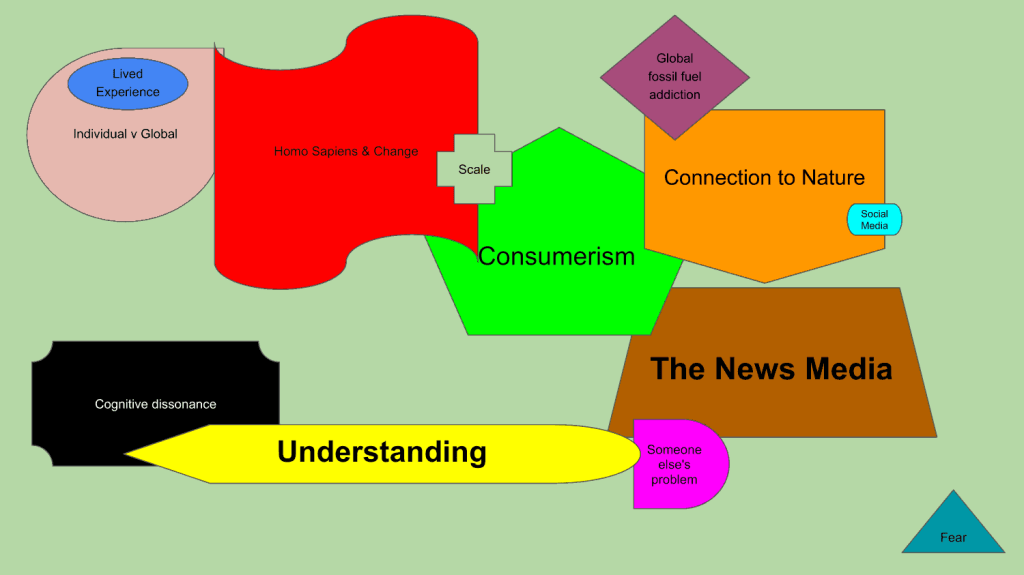
The notion of ‘cognitive dissonance’ was explored at the meeting by some with professional skills in psychology. Cognitive dissonance is a bit like ‘doublethink’, holding two contradictory ideas or behaviours without being able to reconcile them. There may be outright psychological denial, or a state where we consciously know the truth and yet have to take holiday flights or invest in unsustainable companies. And what’s the point recycling if our ‘leaders’ are jetting off to get to climate conferences? One thing I felt was missing here was the institutional propaganda that aimed to create fear, uncertainty and doubt in us. Here is another way of thinking about internal and external factors affecting our conscious position:
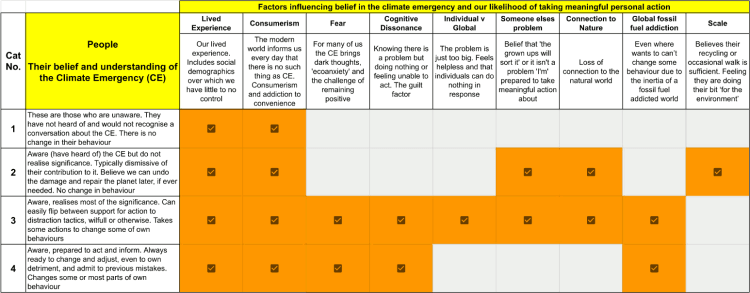
Notes for the presentation by Eamon Gorman follow.
I am going to call the problem the Climate Emergency. I could have chosen a dozen other terms, like Global Warming or Climate Change or Ecological Crisis. I don’t mean to diminish or promote elements carried or missed in any of these.
A trigger warning. Much of what follows is depressing I guess. My plan is to talk to you about how I see the climate emergency through a dozen or so ‘aspects’. … I hope that I can help trigger thoughts and questions to then trigger conversation which may improve our skills in discussing this with others. I really believe there is lots of room for improving how we have dialogue with the people we love, those we work with and those we meet randomly day to day. And for it to be positive dialogue that is circular and not directive. That is a positive bit at the end.
Over the last 6 months especially, and triggered by a conversation that I heard on the radio, I found it helpful to write down the factors that appear to be the most important in that question. And so much is inter-connected and overlapping. Complicating causation. And because it is complex, many can’t see the CE in different ways [see also Mike Hulme, Why we Disagree about Climate Change].
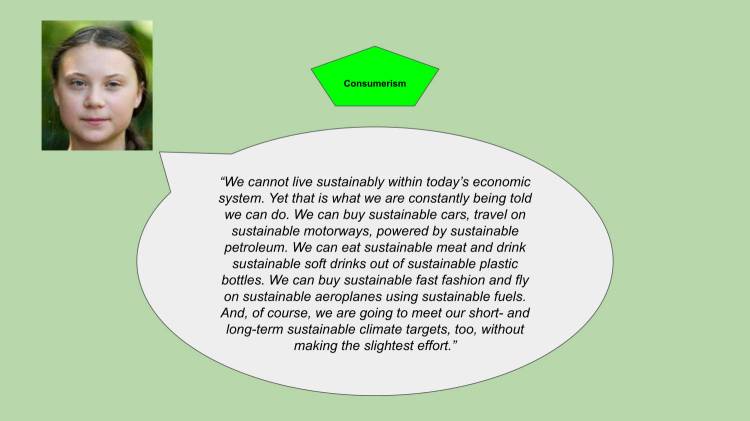
Consumerism
Media

This is a, if not ‘the’, major factor driving inaction on the Climate Emergency front. A worldwide problem in many countries where power and wealth tie up traditional news media into stasis. The status quo works for those holding the reins of power and they operate cynically to resist change.
Those who push back get targeted and vilified. Incendiary and insulting terms like ‘Eco Zealot’ and ‘Climate Warrior’ have become completely normalised in the media. We will never hear mainstream press refer to climate protesters as Eco Advocates or Climate Champions. The same with social media. There are no checks and balances looking to keep in check the spread of lies and misinformation.
And more crucially, well intentioned governments have yet to find a way to truly advocate for a green future. The power of news media operate with them up until the moment they come even close to becoming supportive of regenerative policies, etc. So our leaders fail to take the necessary steps. Green policy will always be the first to go because the government will feel the least amount of backlash over it.
Individual v Global

We all will be troubled by the realisation that the personal act of recycling materials and consuming less is but a drop in the ocean. Why bother with a piddly personal contribution to easing the burden, cycling instead of driving, avoiding plastic, not flying, while at the same time we have this… …nations and states are hell bent on trashing the place? Yes, why bother? Please, please bother.
People may feel no connection to the problem and so take no action. From an evolutionary perspective we are just not hard wired to act to preserve on a global level. There is also a probable assumption running through our subconscious that if the issue was really that bad then we would not be ignoring it. Surely governments and authorities would be on top of it? [For more reflections on different scales of action, see our recent blog covering systemic vs individual.]
Connection to nature
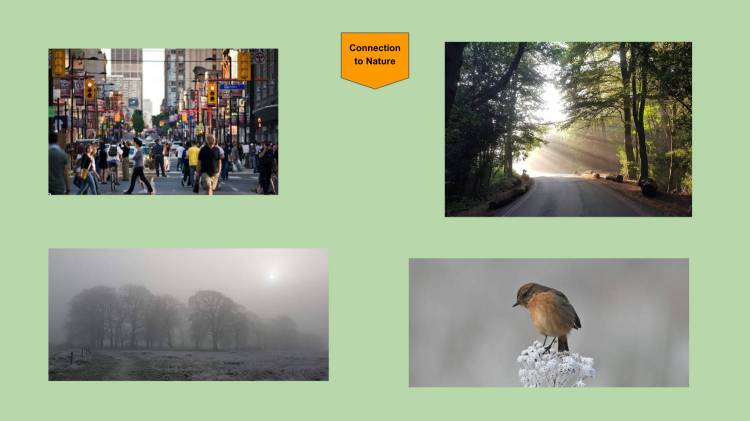
Like never before, more humans now live one step removed from nature and many of us experience way too little of the LIFE that nevertheless abounds. In failing to keep that connection alive it leaves us prone to undervaluing the critical role that the natural world plays in maintaining Earth’s life-giving properties and also how remarkable nature is in sustaining our own mental health and wellbeing.
These scenes are all local to us. But do enough of us care about the natural world to make a difference?
Conclusion
There’s so much more to talk about. Here’s how the slides concluded:
- Our interactions should be non judgmental, enquiring and caring.
- Talk to your partner. I did and it was cathartic. For both of us.
- Research a bit, prepare for the low hanging fruit questions.
- Imagine a world with no [climate movement]. No Greenpeace. Seriously! Now imagine if you had no voice.
- Those around me, like you, inspire me. Think how you will inspire others?
Blog by CK, extracts from Eamon’s notes. Not necessarily the view of WCA.
 Wanstead Climate Action
Shortly after Eamon gave the presentation in this blog, an open-access paper was published that addresses the questions systematically: Orr et al (2025) ‘Breaking the climate silence: Predictors of discussing global warming with family and friends.’
It supports much of the above, and identifies external factors that significantly influence whether people discuss climate, including media and ‘descriptive’ and ‘injunctive’ norms about climate action. It seems to be looking more at positive external influences and media coverage and approval of climate action, but it stands to reason that if there are disapproving norms of climate action or climate speech trasmitted through the media then those norms will make people more hesitant to speak. Other factors associated with more climate conversations are worry and perception of risk, which makes some sense: a trouble shared is a trouble halved, but ‘those who have bad feelings about global warming or perceive it to be a bad thing’ while they may support climate policies, tend to talk about it less. Perhaps we think it is too heavy a burden to share?
The paper is less about the skills we need to start climate conversations and handle them sensitively. But maybe it would get people talking at the stall if we pinned up some worrying newspaper headlines and positive stories about climate action.
LikeLiked by 1 person